
The 4 main impacts of a low FCR rate on customer relations


A low first contact resolution (FCR) rate can have significant consequences for customer relations. Not only does it affect customer satisfaction, it also drives up operating costs, causes lost sales opportunities and lowers employee satisfaction.
In this article, we explore in detail the four main impacts of a low FCR rate on your business, and how to address them.

1. Lower customer satisfaction and recommendations (CSAT & NPS)
According to Harvard Business Review, reducing customer effort is the factor with the greatest impact on loyalty.
Accenture's research reaches the same conclusion. According to Accenture, a poor customer experience is one of the main reasons customers leave:
46% of customers switch providers after a bad experience with a company.
47% immediately stopped doing business with a company after a bad experience.
Looking more closely at what makes a bad experience, Accenture found that the three main sources of customer frustration were:
- Having to contact the company several times for the same reason (cited by 60% of respondents)
- Dealing with unpleasant or rude employees (56%)
- Promises made at the time of purchase not being kept (55%)
The number one source of frustration is tied to first call resolution. It follows that improving FCR could benefit customer satisfaction.
That is exactly what a study by SQM Group shows: a 1% improvement in FCR leads to a 1% improvement in customer satisfaction. This clearly highlights the correlation between FCR and customer satisfaction.
In other words, the more calls it takes to resolve a problem, the more the customer's perception deteriorates. When resolution required 2 or more calls, the average NPS drops to 35. More alarming still: NPS falls to -27 when a request is not resolved at all.
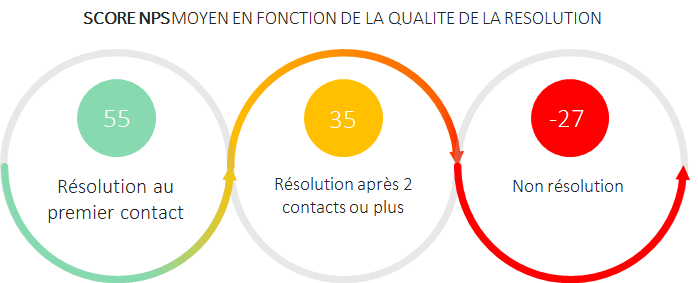
Companies are aware of this, yet the customer service-related sources of customer frustration have barely changed in recent years. Companies are struggling to improve their FCR.
SQM Group highlights these difficulties, noting that the average contact center has an FCR of 70%, meaning 30% of customers have to call again because their first call did not resolve their issue.
Despite these difficulties, 93% of customers who contact call centers expect their issue to be resolved on the first contact.
2. Higher operating costs
A high callback rate doesn't just hurt customer satisfaction; it also generates operating costs for the company.
Put simply: every customer callback has to be handled by an agent, which generates costs for each new contact (cost of calls) and for each time the dedicated team handles the case (cost of multiple handlings). When problems are resolved in a single call, the company is more efficient and the agent can move on to the next caller.
The cost of resolving a customer problem (cost per call resolution) is the cost per call x the average number of calls needed to resolve a problem.
Let's take France and North America as an example:
In France, the average cost of a contact center call is €5.50, compared with €7.22 ($8.82) in North America.
On average, a customer has to call 1.4 times to get their request resolved by phone. Contact centers in the global top 5% achieve 82% first call resolution (FCR), meaning only 18% of customers have to call back to resolve their problem. This translates into an average of 1.1 calls per customer to get a resolution.
The average cost per resolution is therefore:
- €7.70 (€5.50 x 1.4) in France
- Compared with €10.12 ($12.35) in North America

3. Lost sales, up-sell & cross-sell opportunities
All studies agree that every instance of customer dissatisfaction affects a company's revenue. In call centers, a low FCR rate can affect revenue in several ways.
To measure these effects, let's look at several studies that shed light on the issue and on the potential shortfall in sales.
Customer loss
One of the direct effects of a low FCR rate relates to churn, and therefore to customer loyalty. SQM's FCR study highlights this link: according to its research, 23% of customers whose first call goes unresolved say they intend to leave the brand.
Time spent on sales calls
When agents handle both service and sales calls, the time saved by improving FCR lets them spend more time on sales (or high-value calls) and thus increase the company's revenue.
In other words, giving more time to high-value sales calls increases the company's revenue.
Conversely, a low FCR rate prevents agents who handle both inbound and sales calls from making the most of new customer acquisition and up-sell and cross-sell opportunities.
Additional services and cross-selling (up-sell & cross-sell)
When a request is resolved, the customer conversion rate for additional services rises by 20%.
SQM's research shows that the customer's needs must be resolved before the agent moves on to any kind of sales activity if you want to optimize results.
If the agent cross-sells before the request or problem is resolved, the customer usually becomes irritated and feels the agent is brushing their needs aside instead of addressing them.
As a result, the customer relationship and trust are weakened. Hence the importance of improving FCR to boost customer loyalty and increase sales.
Acquiring new customers
We all know the saying:
"A satisfied customer tells 2 people; a dissatisfied customer tells 10"
It is easy to see that a dissatisfied customer shares their experience and makes much more noise than a satisfied one.
Even if this customer service maxim is poorly documented, it illustrates the word-of-mouth effect, here amplified fivefold for dissatisfied customers.
Except that today, word of mouth has gone digital, particularly on review sites, and can multiply this factor by thousands for some companies.
88% of consumers read reviews before deciding to buy a product or service. (Source: IFOP)
When these reviews are read by thousands of customers, the share of negative reviews influences consumers' choices.
In the age of the "expert consumer", who is well informed and increasingly puts brands in competition with one another, almost all respondents (96%) highlight the negative impact online reputation can have on their decision to buy a product from a particular retailer.
In 66% of cases, negative comments lead them to postpone their purchase:
- Either by taking extra time to think it over (39%),
- Or by going to a store to see the product in person (27%).
4. Lower employee satisfaction (ESAT)
We have seen that FCR is logically used to improve customer retention, reduce costs and increase sales.
It is therefore no surprise that FCR is considered a measure of how effectively your contact center operates to deliver on this trio:
- Satisfaction
- Costs
- Sales
The quality of the customer experience also depends on the quality of your agents' conversations. And that depends largely on the quality of agent training and motivation.
For every 1% improvement in FCR, there can be a 1% to 5% improvement in employee satisfaction. (Source: SQM)
As SQM Group's study shows, there is a direct relationship between first call resolution (FCR) and employee satisfaction. Call center agents who are good at solving customers' problems receive praise from management and positive feedback from customers, which builds their confidence and increases their job satisfaction.
Conversely, an agent experiences a very high level of stress when handling a customer's second or third call about a problem that was not resolved on the first contact.
Conclusion
A low first contact resolution (FCR) rate can have harmful consequences across several areas of your business. It directly affects customer satisfaction (CSAT), increases operating costs, reduces sales opportunities and hurts employee satisfaction (ESAT). Combined, these effects can undermine your company's overall performance and weaken your customer relationships.
FCR should therefore be treated as a key metric. Investing in improving it is essential to optimize your company's overall performance and strengthen your customer relationships.