How to calculate and reduce average talk time in a call center


In a call center, every customer interaction is an opportunity to strengthen satisfaction and loyalty. Yet one question remains: are your agents spending too much or too little time on the phone? Average talk time (ATT) is a key indicator that can help you answer this question and improve the efficiency of your customer service.
Whether you are dealing with talk times that are too long, signaling inefficiencies, or too short, suggesting a lack of depth in conversations, this article gives you the keys to measure, interpret and optimize average talk time so that every call becomes a positive customer experience.
What is average talk time?
Definition
Average talk time, or ATT for short, measures the average time an agent spends interacting directly with a customer during a call. It is a crucial KPI that helps assess how effective these interactions are.
When interpreted correctly, this metric lets you make the adjustments needed to improve agent training or your customer service's internal processes.
Why is average talk time not enough?
Average talk time is part of a set of key measures for assessing the efficiency of calls in your contact center. These measures include hold time and after-call work (ACW), defined as follows:
- Average talk time (ATT): The average time an agent spends talking directly with a customer during a call.
- Hold time: The average time a customer is put on hold during a call.
- After-call work (ACW): The average time the agent spends on administrative tasks after the call ends, such as entering notes or updating the database.
Average handling time (AHT) combines these three indicators and is calculated simply by adding them together:
AHT = ATT + hold time + ACW
By measuring AHT, you get a more complete overview of your agents' efficiency and productivity. This holistic approach helps identify opportunities for improvement at every stage of the call handling process.
For example, a short talk time combined with high hold time or ACW could indicate that agents spend too much time on non-conversational tasks, which could be a sign of inefficient processes or training needs.
AHT therefore offers a broader perspective that helps you better assess your call center's performance, manage resources more effectively and improve customer satisfaction. By taking every stage of call handling into account, you can make more precise and relevant adjustments to improve the overall performance of your customer service.

How do you calculate average talk time?
Formula
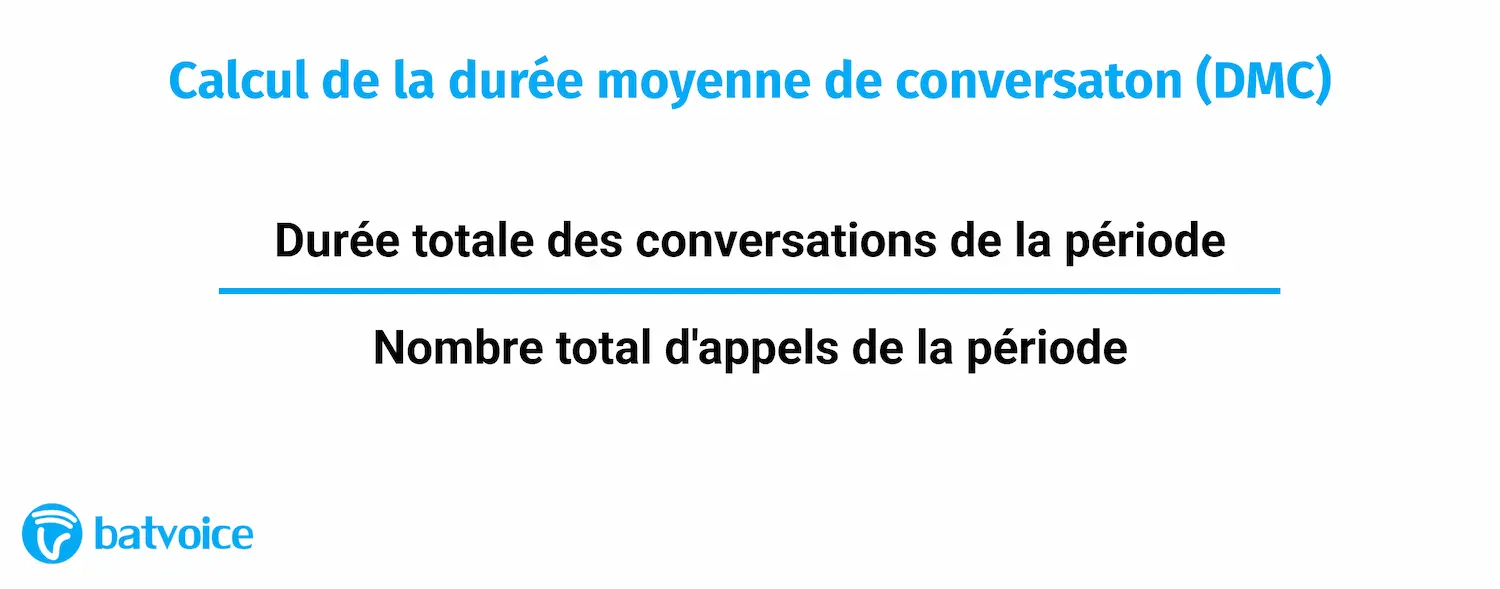
To calculate average talk time, add up the total duration of all conversations over a given period, then divide by the total number of calls.
The formula is therefore:
ATT = Total conversation time for the period / Total number of calls for the period
For example, if total talk time over one day is 300 minutes for 100 calls, the average talk time is 3 minutes.
How should you interpret average talk time?
Average talk time is a useful tool for measuring how effectively your agents resolve customer issues. However, it must be interpreted with nuance and in context:
A long talk time can indicate inefficiencies, training issues or complex internal processes. But in some industries, the complexity of products, services or requests naturally requires more time to handle.
Conversely, a very short talk time could mean agents are not taking enough time to resolve complex requests, which could hurt customer satisfaction. On the other hand, a short talk time could also be a sign of efficiency and fast handling.
It is therefore essential to take into account the specifics of your industry and your customers' expectations to make informed decisions based on this KPI.
Average talk time by industry: examples
As explained above, average talk time varies considerably by industry. Here are some averages by sector, based on data from Call-Center Magazine:
| Industry | Average talk time (minutes) |
|---|---|
| Consumer services / Professional services | 3.55 |
| Financial services and insurance | 4.01 |
| Government and public sector | 4.13 |
| Healthcare | 3.38 |
| Hospitality and food service | 3.11 |
These average talk times illustrate how the nature of customer interactions differs across industries:
- Consumer services / Professional services: With an average talk time of 3.55 minutes, this sector is characterized by relatively short interactions, often focused on customer service questions or quick information requests.
- Financial services and insurance: The 4.01-minute average talk time in this sector is slightly higher, reflecting the complexity of financial questions and insurance products, which usually require detailed explanations and additional checks.
- Government and public sector: With an average talk time of 4.13 minutes, interactions in this sector tend to be longer due to administrative procedures and the detailed information citizens often need.
- Healthcare: The 3.38-minute average talk time in healthcare can be explained by the need to provide accurate medical information and answer sensitive questions while keeping the conversation efficient.
- Hospitality and food service: With an average of 3.11 minutes, this sector stands out for its quick interactions, often related to bookings, questions about services or general inquiries.
How to optimize your call center's average talk time
Strengthen your quality monitoring with speech analytics
Speech analytics is a major asset for quality monitoring processes because it lets you automatically analyze phone conversations between agents and customers.
This artificial intelligence technology, specialized in contact center use cases, can help you understand why talk time is too long, or even too short, by identifying the recurring issues that needlessly prolong conversations.
Support agents' skills development
Improving average talk time inevitably involves ongoing training for your agents to improve their ability to resolve customer issues quickly while still delivering a good customer experience.
With the data provided by a speech analytics tool such as Batvoice AI, you can also give more precise feedback on each agent's performance.
Based on the results of these evaluations, you can offer targeted training on your agents' individual needs and provide personalized coaching to those who need extra support.
Optimize your internal processes and scripts
Develop clear, concise scripts that help agents move quickly through calls while still providing quality assistance. Also make sure to cut unnecessary steps and simplify internal processes so agents can resolve issues faster.
Track and analyze the impact of your actions
Set up dashboards that track average talk time and other KPIs in real time, such as the AHT mentioned above or the first contact resolution rate (FCR), to manage your action plan proactively and continuously.