
The complete guide to first call resolution (FCR)


First call resolution (FCR) is a key performance indicator for call centers and customer service teams. It measures the ability to resolve customers' problems on their very first contact.
Let's explore the impact of FCR, how to measure this KPI, and what actions to take to improve it.
The benefits of a good FCR
Achieving a good first call resolution (FCR) rate significantly improves the customer experience by reducing the effort needed to resolve problems. Customers are more satisfied, which strengthens their trust in and loyalty to the brand.
Loyal customers are more inclined to share their positive experience with others, improving your Net Promoter Score (NPS).
It is also an opportunity to use resources more efficiently. Solving more problems on the first call reduces the number of inbound calls, which means the support team can handle more requests and improve the quality of customer relations.
Finally, a good FCR can have a positive impact on employee satisfaction, which often leads to better customer service.
Causes and impacts of a poor first contact resolution rate
According to an Accenture study, having to contact a company several times for the same reason is the leading cause of customer dissatisfaction.
A poor FCR can be due to several factors, such as:
- Problem complexity: Some problems may be too complex to solve in a single call, requiring several interactions for a full resolution
- Insufficient internal documentation: A lack of clear, accessible documentation on common problems and their solutions can prevent agents from providing effective answers
- Agent training issues: Poorly trained agents may lack the skills or knowledge needed to solve customer problems on the first call
- Lack of tracking and analysis: Failing to track and analyze the reasons for repeat calls can prevent you from identifying recurring problems and putting effective solutions in place
Failing to meet customers' needs quickly has many consequences, such as lower customer satisfaction, which affects the brand's reputation and long-term customer loyalty.
40% of customers switch to a competitor because FCR was not achieved by their original provider.
In addition, the extra influx of support requests leads to higher operating costs, as more resources are needed to handle the increase in support tickets.
Agents can suffer from high stress due to the increased workload, which can lead to lower productivity and higher turnover. The result is additional costs for recruiting and training new employees.
We discuss this in more detail in our article on the impact of a high customer callback rate.

How do you measure your customer service FCR?
Calculating FCR (with an example)
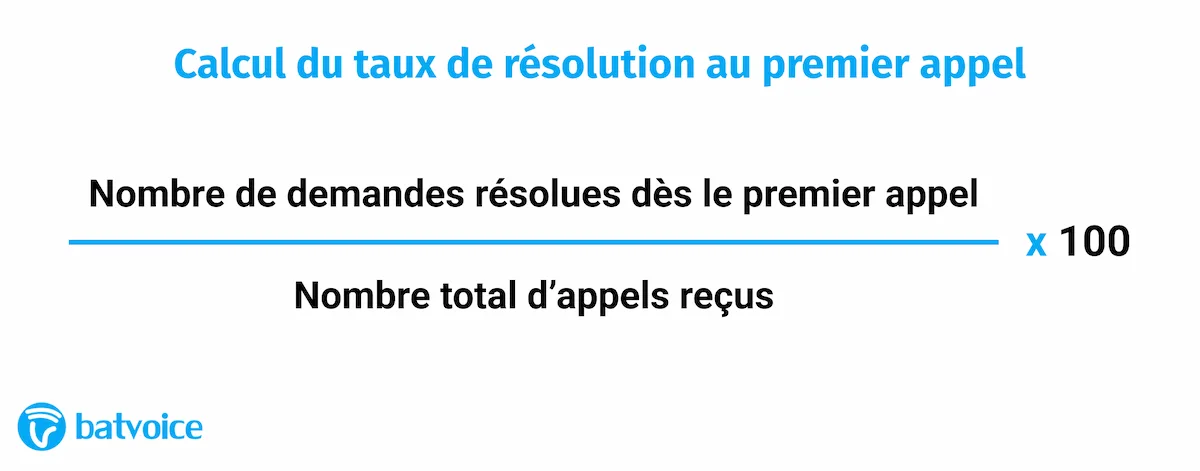
FCR is calculated by dividing the number of requests resolved on the first call by the total number of calls received, multiplied by one hundred.
Imagine a call center that receives 1,000 calls and resolves 720 of them on first contact. Its rate would then be 72%.
According to SQM Group, a good first contact resolution rate is between 70% and 79%, with the average just under 70%.
The different measurement methods
To maintain or improve your quality of service, regularly assessing your performance is essential. There are many ways to get a realistic overview of your FCR performance, such as:
- Post-call phone surveys
- Post-call email surveys
- Inbound and outbound post-call IVR (interactive voice response) surveys
- Surveys conducted by an agent during the call
- Automatic detection of repeat calls
- CRMs and ticket management
- Speech analytics (artificial intelligence for automated quality monitoring)
None of these methods is perfect on its own. It is therefore essential to combine several methods to compensate for their respective weaknesses.
We detail the pros and cons of each method in this article to help you choose.
How can you improve your first contact resolution score?
What isn't measured can't be improved. That's why the first step is to get access to your phone call data so you can put concrete strategies in place.
You can turn to a speech analytics solution such as Batvoice, which automatically analyzes every call in your contact center to extract actionable data. In doing so, we can automatically identify your customers' recurring problems and assess the quality of conversations so you can adjust your FCR strategy.
In our article with 5 tips to improve FCR, we recommend focusing on the following actions:
1. Identify recurring problems in your customer journey
Analyzing call topics lets you trace recurring elements in what customers say, such as frequent questions and pain points, and categorize these topics to better understand and improve the customer journey.
2. Prioritize customer requests with a high churn risk
With an artificial intelligence technology such as Batvoice AI, you can use semantic and emotional criteria to identify customers at risk of churning. This lets you prioritize callbacks based on the intensity of the pain points detected and avoid losing customers.
3. Set up a real-time alert as soon as an at-risk call is detected
Detect at-risk calls by defining relevant criteria, such as the CSAT score or specific keywords, so you are alerted in real time and can act quickly. For example, keyword detection rules let you track calls in which critical terms are mentioned.
4. Offer personalized training based on your agents' needs
Identify and offer targeted training to agents so they can better handle the situations that lead to customer callbacks. Better customer conversations make processes run more smoothly.
5. Track the impact of your actions regularly
Build a dashboard to track, over time or over a given period, the impact of your actions on FCR, customer pain points and the quality of agents' conversations, so you can adapt your strategy as your performance evolves.