
CSAT: definition, calculation and tips to improve customer satisfaction


In a world where the customer relationship plays a major role, you must constantly work to improve your customers' satisfaction and loyalty. It is essential to optimize every aspect of how you produce and deliver your services.
Among the tools available, CSAT stands out as a key metric for assessing your customers' satisfaction after they interact with your company. By relying on CSAT, you can gather valuable feedback that will help you adjust your strategies and better meet your customers' needs.
This article explores what CSAT is, how to measure the score, and why this metric matters in maintaining a positive customer relationship.
What is CSAT?
The Customer Satisfaction Score (CSAT) is a crucial metric for measuring your customers' satisfaction after an interaction with your company. The score is obtained through post-interaction surveys that capture customers' feelings while their experience is still fresh.
The ultimate goal is to turn the data collected through CSAT into concrete actions that not only improve the customer experience but also increase loyalty and encourage customers to come back. Used correctly, this score becomes an essential strategic tool for aligning your strategies with your customers' real expectations and needs.
What are the benefits of CSAT?
The CSAT score is simple to visualize, easy to interpret and perfect for use right after a customer interaction. It helps you collect customer feedback efficiently and adjust your strategies based on the results.
1. Accurate results
CSAT provides accurate results that reflect reality thanks to its simple, standardized calculation method. This helps clearly identify sources of frustration and understand customer expectations. This information is crucial to better meet their needs and optimize their customer experience.
2. Simplicity
CSAT questions are usually clear, concise and easy for everyone to understand. This format encourages more customers to respond, resulting in a large volume of useful, reliable answers. When customers find it easy to give feedback, it improves the quality of the data collected and ensures an accurate assessment of their satisfaction level.
3. Reliability
Because the question and the answer options are simple, you get a large number of responses. As a result, the results are highly representative and therefore a reliable measure of customer satisfaction.
4. Universal application
Because CSAT questions are so clear, you can ask them to all customers without having to segment your customer base. This gives an overall picture of customer sentiment and lets you address every point of the customer journey consistently.
5. Versatility
CSAT is a versatile metric. It can assess different aspects of a product or service, making it easier to understand the various sources of satisfaction and dissatisfaction. This lets you adjust your offers to improve customer loyalty.
6. Real-time results
With this immediate feedback, you can quickly identify unhappy customers and step in without delay. This helps maintain a high level of customer retention and reduce churn. Getting results quickly is essential to take corrective action before problems get worse.
How to measure your CSAT score
To measure your customers' CSAT score, a satisfaction survey must be carried out immediately after a key interaction.
The most common way to do this is to ask a direct question such as:
"Are you satisfied with our products / services / the answers provided?"
Users must be able to give a clear, concise answer in a simple, intuitive and efficient way. Offer one of two types of answers:
- Yes / No
- Rating scale: very satisfied, satisfied, neutral, somewhat dissatisfied, not at all satisfied.
The rating scale is often preferred because it provides more detailed data. You can also use scores from 1 to 5, stars or smileys.


How to create an effective CSAT survey
A well-structured CSAT survey is essential to measure customer satisfaction accurately. Here's how to do it:
- Write clear questions: Make sure each question is simple and direct. Avoid jargon so that all respondents understand.
- Use a simple scale: A scale from 1 to 5 or 1 to 10 is commonly used to measure satisfaction. It lets customers rate their experience easily.
- Add a comments field: Providing space for free-text answers lets customers explain their rating. This feedback can provide valuable insights.
- Collect feedback while it's fresh: It is important to gather feedback shortly after the customer interaction or purchase to get accurate, authentic answers.
By following these steps, you will maximize the effectiveness of your CSAT survey while improving the customer experience.
CSAT: calculation methods
To calculate CSAT (Customer Satisfaction Score), you first need to choose a suitable measurement method based on the type of answer you have chosen to offer the customer.
One of the most common approaches uses a rating scale from 1 to 5. On this scale, an answer is considered:
- Positive if it is rated 4 or 5.
- Negative if it is between 1 and 3
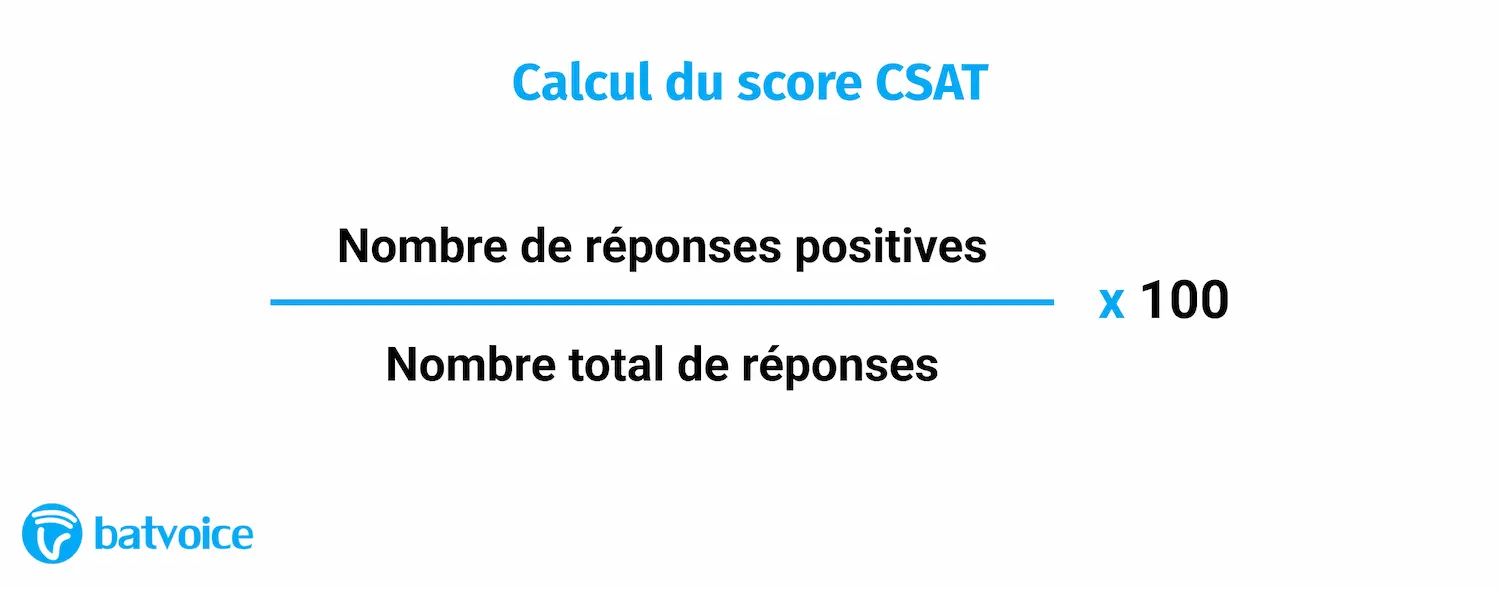
The formula for calculating CSAT is simple:
CSAT = (Number of positive responses / Total number of responses) x 100
By monitoring these scores, you can use customer satisfaction data to identify areas for improvement.
Keep in mind that response rates can vary, which can affect the accuracy of CSAT. That is why it is important to collect enough responses to get a reliable result.
What is a good CSAT score?
A very good CSAT score is generally above 80%. It shows that most of your customers have a positive opinion of your brand.
Conversely, if the score is below 50%, the result is negative, meaning that most customers are unhappy.
Note that expectations can vary from one industry to another. Hence the importance of comparing your score with your industry's benchmarks.
What are the limitations of CSAT?
The CSAT (Customer Satisfaction Score) has several limitations that are crucial to understand in order to interpret the results correctly. Here are the main ones:
Partial results
CSAT measures customer satisfaction at a specific moment. This means that you are not assessing the customer's overall experience with your brand over time. In other words, it does not capture how satisfaction evolves or long-term engagement with your product or service.
Biased answers
Results can often be influenced by customers' state of mind when they answer the survey. Their mood or a particular recent experience may affect their answers, making CSAT not fully representative of their actual satisfaction.
Low response rate
CSAT surveys can sometimes have a low response rate. In addition, it is often those who have had a bad experience who tend to respond to the survey to express their dissatisfaction. This tendency can skew the score by amplifying negative opinions, when the goal is to represent your entire customer base.
Incomplete measurement
CSAT assesses a specific interaction but does not take into account every aspect of the customer relationship, such as loyalty or advocacy. To get a complete picture, you therefore need to combine CSAT with other metrics. We cover this in the next section.
Other customer satisfaction metrics
Net Promoter Score (NPS)
NPS, or Net Promoter Score, is a valuable tool for understanding whether your customers are willing to recommend you.
The central question is often:
"On a scale of 0 to 10, how likely are you to recommend us to a friend or colleague?"
The results are divided into three categories:
- Detractors: Those who give a score from 0 to 6. They are not satisfied and could potentially harm your reputation.
- Passives: With a score of 7 to 8, they are satisfied, but not enough to actively recommend your brand.
- Promoters: Those who answer 9 or 10. They are highly satisfied and ready to recommend your services.
In other words, satisfaction here goes hand in hand with loyalty: a loyal customer is more likely to recommend the brand to others, while a customer who is merely satisfied will not necessarily do so.
By combining CSAT with NPS, you can better understand how strong your customer relationships are.
Customer Effort Score (CES)
CES, or Customer Effort Score, measures how easily a customer can complete an action with the brand, such as a purchase.
A typical question might be:
"How much effort did you have to put in to complete your purchase/other action?"
This survey helps identify obstacles within your services, such as navigating your website, the payment process and so on.
Unlike CSAT, which assesses satisfaction, CES identifies friction points that could discourage your customers and push them toward your competitors.
CES is based on the following reasoning: customer satisfaction depends partly on how much effort the customer has to make to complete their action.
Using these two complementary tools, CSAT and CES, gives you a more complete view of the customer experience.
What actions should you take after measuring CSAT?
1. Analyze the results
Once you have measured your CSAT score, it is important to understand why customers gave you the scores they did.
Asking an additional question such as "Why?" lets you collect open-ended feedback from customers. These answers, called "verbatims", provide valuable information on the reasons for satisfaction or dissatisfaction.
To analyze these verbatims, it helps to use semantic analysis tools, such as Batvoice's AI. These tools categorize recurring themes and convert this information into percentages to better understand trends. This helps you quickly spot problems or identify what works well in your services as part of a continuous improvement approach.
2. Automated actions
Using CSAT scores, you can set up automated actions tailored to customers' satisfaction levels.
For those who gave a low score, for example 1 or 2 out of 5, you can set up an automatic notification to your customer support team. This allows them to initiate a personal follow-up to solve the problem and protect your brand image.
Likewise, for those who give high scores such as 4 or 5, you can automate thank-you messages. Offering perks, such as loyalty points, or encouraging them to share their positive experience strengthens your relationship with customers and improves their satisfaction.
These actions build their trust in your brand by showing that you pay attention to how your customers feel.
3. CSAT as a marketing argument
The CSAT score can be a powerful asset in your marketing strategies. Use it to showcase your customers' satisfaction in advertising campaigns, interviews or public presentations. Mentioning a high CSAT score builds trust and makes your products or services more attractive.
You can also use positive verbatims in your marketing campaigns. By quoting positive feedback on your website or in your ads, you use real feedback as a testimonial to the quality of your customer service. This becomes a strong argument for attracting new customers and maximizing your revenue.
How to improve your CSAT score
To improve your CSAT score, you need a methodical approach. Here are a few strategies to improve it effectively:
- Collect feedback: Encourage your customers to give their opinion regularly. Use post-purchase surveys by email, phone or in person to understand their satisfaction level and identify areas for improvement.
- Analyze the results: Carefully examine survey results to spot trends. Pay particular attention to negative or recurring issues that need your attention.
- Train your staff: Make sure your team is well trained to respond to customers' needs and concerns. The ability to solve problems quickly and effectively can significantly improve your CSAT score.
- Continuously improve the product: Ask for product feedback to understand weak points and make improvements based on customers' comments. A product that better meets consumers' expectations generally leads to a higher satisfaction rate.
- Communicate transparently: Always be transparent with your customers. Let them know about changes or obstacles you face and how you plan to resolve them.
How can Batvoice help?
Batvoice's artificial intelligence analyzes exchanges between agents and customers to extract key information about customer satisfaction.
Our solution integrates the CSAT score collected through third-party solutions immediately after each interaction with customer service. By analyzing CSAT and customer verbatims during calls, Batvoice can align survey answers with the mood of the call.
If a negative score or strong anger is detected during the call, Batvoice suggests immediate corrective actions to agents to resolve the customer's dissatisfaction.
By analyzing the voice of the customer, our technology spots recurring words in the customer's vocabulary and identifies the key moments of the call. This makes it possible to classify calls by topic and more easily spot the recurring issues related to each theme.