
Churn rate: definition and tips to reduce customer churn

Churn rate, or attrition rate, is a crucial metric for any company looking to assess customer loyalty. It measures the proportion of customers who stop using a product or service over a given period.
Understanding and optimizing this rate can significantly influence your company's profitability and growth. This guide covers everything you need to know to reduce your churn and retain your customers.
What is churn rate (or attrition rate)?
Definition of churn
Churn measures the percentage of customers, users or subscribers you lose over a certain period. It is an essential metric for analyzing the effectiveness of retention strategies. It directly affects companies' revenue and growth, especially subscription-based businesses.
What are the different types of churn?
Churn, or customer attrition, can be categorized in several ways. Understanding these distinctions is crucial to building effective retention strategies:
- Voluntary churn occurs when customers actively choose to leave. It is usually caused by dissatisfaction with the service, a better offer from a competitor or a change in needs.
- Involuntary churn happens without a deliberate decision by the customer. Causes include billing problems, expired credit cards or the customer's death.
- Contractual churn occurs at the end of a fixed-term contract. It is particularly common for B2B companies and subscription services such as SaaS software.
- Partial churn is when customers reduce their commitment without leaving completely. This can include cutting back on the number of services or the amount spent.
- Seasonal churn is a predictable fluctuation in attrition linked to specific periods. It is common in certain industries such as tourism and retail.
- Hidden churn occurs when customers stay but no longer actively use the product or service. If not addressed, it creates a high risk of future churn.
By tailoring your efforts to each type of churn, you can significantly improve your customer retention rate, support long-term growth and optimize the customer lifetime value of your user base.
What is an anti-churn campaign?
An anti-churn campaign aims to reduce the number of customers who leave. It includes specific actions to increase retention, such as personalized offers or improved customer service.
The goal is to turn at-risk customers into active customers. In subscription-based models, these campaigns are essential to maintain a good retention rate.
We will look at the different strategies for reducing churn in detail later in this article.
How to calculate customer churn rate
Formula for monthly and annual churn
Churn rate is often calculated on a monthly or annual basis, but it can be calculated over any period you choose.
The formula consists of dividing the number of customers lost during the period by the total number of customers at the start of the period, then multiplying the result by 100 to get a percentage.
In other words, monthly churn is calculated as follows:
(number of customers lost during the month / number of customers at the start of the month) * 100
For example, if you had 200 customers at the start of the month and lost 25 during it, your churn rate is 12.5%.
For annual churn, apply the same method over a twelve-month period.
For example, if you start the year with 1,000 customers and lose 100 during the year, the annual churn rate would be 10%.

Calculating revenue lost to churn
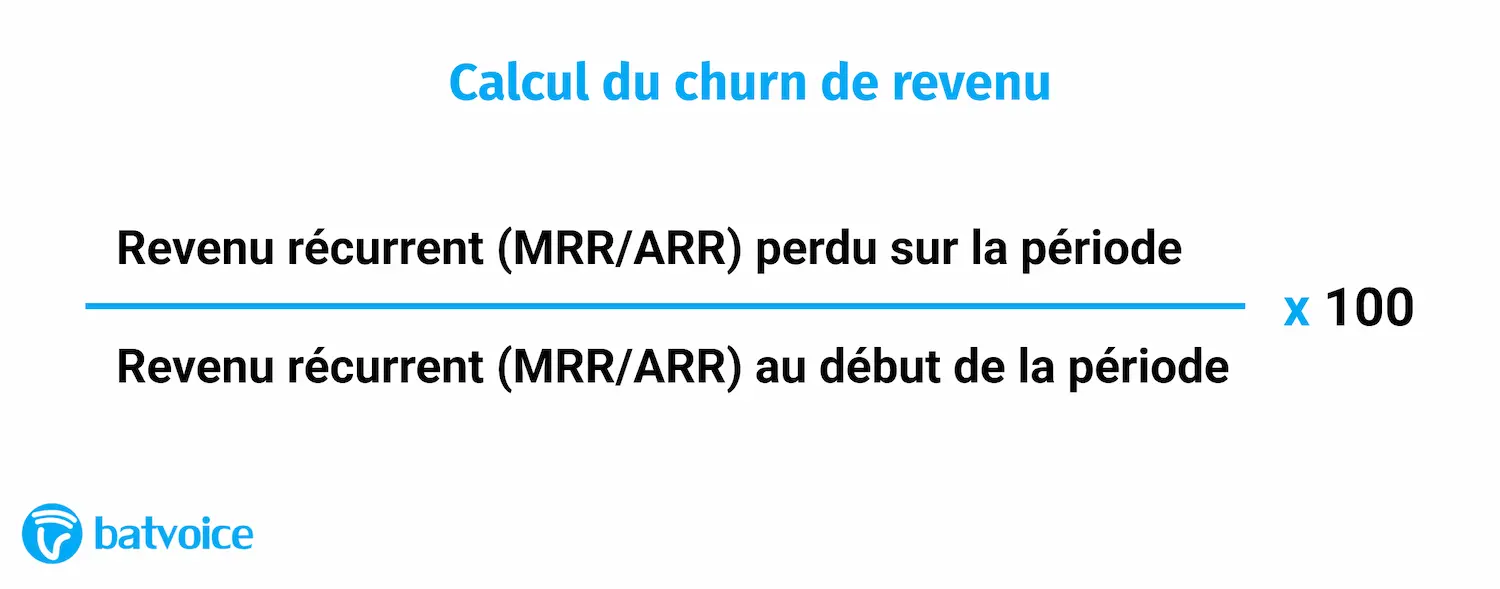
Revenue churn measures the revenue lost as a result of losing customers.
To calculate it, divide the monthly recurring revenue (MRR) lost to churn over a given period (month or year) by the total MRR at the start of the period. Then multiply the result by 100:
(MRR lost over the period / MRR at the start of the period) * 100
For example, if you lose €5,000 of MRR out of an initial MRR of €100,000, revenue churn is 5%.
What is a good attrition rate?
What is considered a good churn rate across all industries
Although there is no consensus on the question, a good churn rate across all industries is generally considered to be between 2% and 8%.
These figures should be taken with a grain of salt, as average churn varies greatly depending on your industry and your company's size and stage of development.
Your ability to keep churn low reflects good customer retention and effective management of your business, which directly affects your long-term growth.
Examples of average churn rates by industry
To properly assess your customer retention performance, you cannot rely on generic figures. Each industry has its own specifics that change the benchmark average churn rate.
Here are a few examples:
- In telecommunications, annual churn generally ranges from 12% to 24%
- In banking, annual rates are around 5% to 15% thanks to a more stable customer relationship.
- The SaaS sector generally aims for 5% annual attrition
When is a high attrition rate normal?
A high attrition rate can be considered normal or acceptable in certain specific contexts:
- Early-stage companies: Start-ups and companies in their launch phase are still adjusting their product or service to better meet market needs. A SaaS start-up in its first year of business may have a churn rate of 10-15% because the company is still finding product-market fit.
- Short-cycle services: Some monthly services or subscriptions, such as streaming subscriptions or monthly product boxes, can naturally have higher attrition rates. Customers may sign up for a short period to take advantage of a special offer or try the service, then decide not to renew.
- Seasonal variations: In some industries, customer fluctuations can be normal at certain times of the year. For example, a home meal delivery service may see higher churn in summer, as customers cook more at home during the holidays.
- Highly competitive industries: In very competitive sectors, customers often switch providers to take advantage of better offers. As seen above, a mobile operator can have an annual churn rate of 12-24% without it being considered abnormal.
- Single-use or infrequently used products: Some products or services are used on a one-off basis or for specific events. For example, a wedding planning app can have a high churn rate (up to 80-90% after use), because users no longer need the service once their wedding is planned.
- Companies pivoting or undergoing major change: Companies going through major transitions can experience temporarily high attrition. A software company moving from a licensing model to a SaaS model may see temporarily high churn (15-25%) during the transition, as some customers prefer the old model.
In these cases, ongoing monitoring and periodic adjustments are essential to understand the reasons behind a high attrition rate and put suitable strategies in place.
What are the risk factors for attrition?
Customer dissatisfaction
Dissatisfaction often occurs when there is a negative gap between customers' expectations and reality.
You need to measure customer satisfaction regularly to identify problems quickly, because a dissatisfied customer is more likely to turn to the competition. In addition, negative online reviews can damage your reputation if they are not dealt with quickly.
To reduce dissatisfaction, personalize your communications and pay attention to customers' changing needs. Handling complaints proactively can reverse negative perceptions and improve loyalty.
Poor customer service management
Customer service management is crucial for your business. If your customers feel neglected, they will look elsewhere.
Long wait times and automated responses can frustrate customers. They would rather be heard by a real person who understands their concerns than deal with a scripted bot. Sometimes, simple empathy can make all the difference.
Failing to resolve customer issues on first contact is also a key driver of churn. In fact, according to a study by SQM Group, 40% of customers switch to a competitor because their issues were not resolved on first contact with their original provider.
It is therefore essential to invest in training your staff and give them all the tools they need to communicate effectively and resolve customer issues quickly.
Poor product or service quality
The quality of the product or service directly influences customer satisfaction. A defective product or mediocre service pushes customers to look for better alternatives.
Customer loyalty depends partly on the perceived value of your offer, but it is above all influenced by its actual value. Offering a product that meets customers' expectations therefore reduces the risk of customers leaving.
Competition and the market
Competition is a major factor in customer attrition. Your competitors may offer more attractive or innovative offers. Analyzing your product's positioning relative to the market will help you identify your strengths and weaknesses.
It is therefore vital to stay informed about market trends and competitors' strategies so you can adapt your own.

Our tips for reducing your churn rate
Identify the reasons for churn
To reduce churn, the first and most important step is to identify the reasons that lead your customers to leave your company.
Use analytics tools and run surveys and interviews to gather data on attrition behaviors and understand where the problem lies.
By understanding what drives these departures, you can adjust your offers and your organization, and improve the customer experience.
Predict the risk of customers leaving
Predicting which customers are at risk of churning is essential to put preventive measures in place.
Use churn prediction models based on the analysis of existing data to determine which customers are at risk.
This is exactly what Batvoice does with its speech analytics technology, which analyzes the calls in your contact centers to detect attrition risks and alert you.
You can then apply a proactive customer retention strategy and turn potential detractors into promoters of your brand.
Listen to the voice of the customer continuously
Don't take your customer knowledge for granted: you need to keep it up to date. Constantly listening to your customers will help you adjust your services to their changing needs.
To do so, you can gather online reviews and analyze the information contained in your various customer interactions.
Also build regular customer feedback mechanisms into your retention strategy, such as surveys or feedback sessions, to strengthen trust and improve the customer experience.
Improve your first contact resolution (FCR) rate
Excellent customer service often translates into a high first contact resolution rate.
To achieve this, you first need to identify the recurring problems in your customer journey. Then you need to detect and prioritize customer requests with a high churn risk.
Don't forget to train your team properly on customers' recurring problems so they can solve them faster and more effectively.
We discuss this further in our article sharing our tips for improving FCR.
Hire the right people
Recruit people who are passionate, skilled and able to represent your brand positively across your sales team, your operational agents and your customer contact center.
Well-trained, motivated employees are better able to deliver excellent service, which improves customer retention.
How can speech analytics help you limit churn?
Speech analytics uses artificial intelligence to analyze the thousands of hours of phone conversations in your call centers. This technology can even analyze emotions to detect anger and pain points.
Your customers may be expressing frustrations or recurring problems on the phone that are impossible to identify and quantify by hand. But with speech analytics software like Batvoice, you can accurately measure the reasons for churn and be alerted to at-risk customers.
By identifying recurring problems and being alerted to potential customer departures, you can make targeted improvements to your services and reduce your churn rate by boosting customer satisfaction.