
What is quality monitoring?


In a world of fierce competition and constantly evolving customer expectations, delivering exceptional customer service is no longer optional: it is a necessity. Companies must not only meet their customers' needs but also anticipate their expectations to stay competitive.
It is in this demanding context that quality monitoring becomes so important. A true pillar of operational excellence, quality monitoring lets you continuously measure, analyze and improve the quality of your customer relations.
But how do you set up an effective quality monitoring system? What tools are essential, and which best practices should you adopt? Read on to find out how to turn your customer service into a real driver of satisfaction and loyalty.
What quality monitoring is and why it matters
Quality monitoring is a key element of quality management. It consists of evaluating and measuring the quality of interactions between agents and customers, or within a product or service. It helps maintain high standards of performance and customer experience.
Quality monitoring offers several important benefits for a contact center:
- Optimize the operational management of teams: by evaluating team performance in real time, quality monitoring makes it possible to quickly spot opportunities for improvement. This supports informed decisions to adjust operational strategies and improve overall team efficiency.
- Ensure regulatory compliance of customer conversations: by recording and analyzing customer interactions, QM helps verify that agents comply with regulations and internal policies. This reduces the risk of non-compliance and potential penalties, while ensuring clear and consistent communication with customers.
- Support agents' skills development: the data collected makes it possible to give each agent precise, personalized feedback. This feedback helps identify areas for improvement and offer targeted coaching sessions and training to help agents deliver high-quality customer service.
- Contribute to quality assurance: by providing valuable data on performance and interactions, quality monitoring helps identify trends and recurring issues throughout the customer journey. This information can be used to adjust the company's processes and strategies, contributing to the continuous improvement of service quality.

What criteria should you use to evaluate calls?
Defining clear, precise criteria for evaluating your calls lets you judge the quality of your call center's customer interactions. Several common criteria should be considered to ensure a high-quality customer experience, such as:
- Average handling time (AHT): an assessment of how quickly an agent can handle a customer request.
- Appropriate language and tone of voice: using relevant, clear language and a calm voice is essential to build trust and project a good brand image.
- Ability to reassure the customer: you need to assess how well an agent can ease customers' concerns.
- Active, attentive listening: the agent must show empathy and pay attention to the customer's needs to improve customer satisfaction.
- Call control: an agent's ability to steer conversations effectively is crucial to obtaining the information needed from the customer to meet their need.
- Effective questioning: asking the right questions and getting straight to the point demonstrates the agent's competence and ability to keep the service consistent.
How to set up an effective quality monitoring process
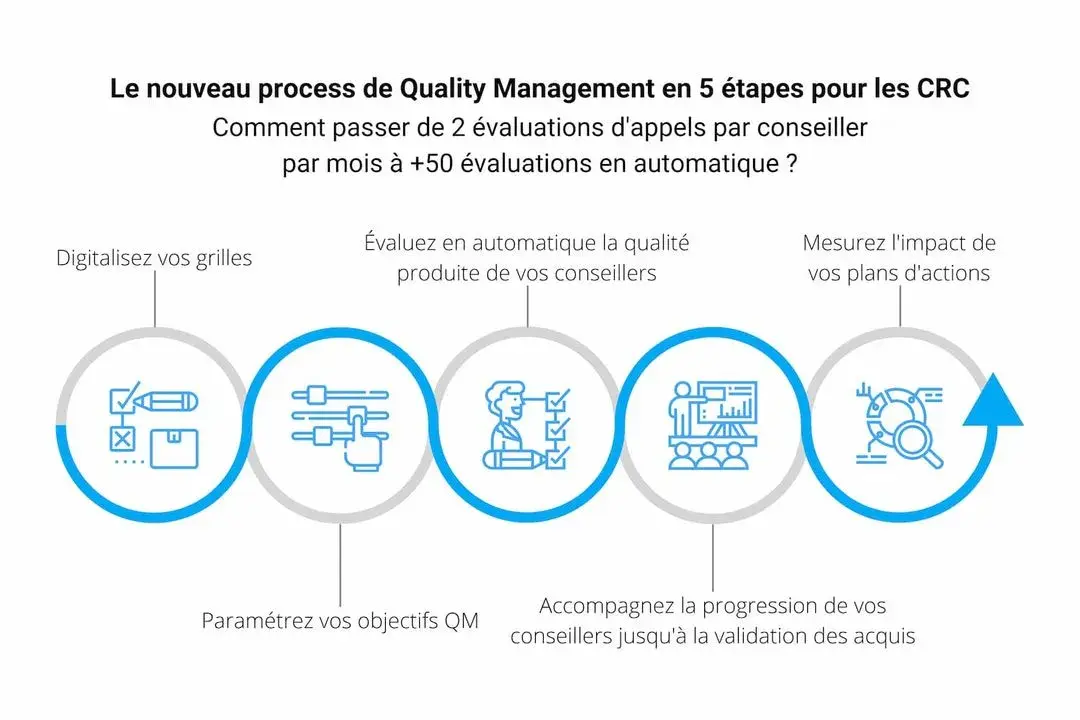
Step 1: Define clear objectives
To start, you need to define objectives that are clear and tied to your business needs and customer expectations. These may include improving customer satisfaction, reducing errors or shortening handling times.
Be specific about what you want to achieve.
For example, aim for a 15% improvement in customer satisfaction within six months. This guides the team and aligns efforts with measurable results.
Step 2: Identify the KPIs to track
Choose the KPIs that best reflect the effectiveness of your customer service. Examples include first contact resolution rate, customer satisfaction (CSAT) and average resolution time.
These key performance indicators will serve as measures to evaluate your progress and adjust your quality monitoring strategies. Make sure they are consistent with the objectives defined earlier to simplify measurement and tracking.
Step 3: Train and involve your teams
Training your teams, managers and agents alike, is essential to reach and maintain high quality standards. Implement ongoing training programs to improve their skills. Training should cover how to use the tools, understanding KPIs, and communication and sales strategies.
Involving teams in the process strengthens their engagement, which increases the chances of success for your quality monitoring initiatives.
Step 4: Build call evaluation scorecards
Create quality scorecards to track the quality of your phone interactions. These include criteria such as communication effectiveness, problem resolution and compliance with protocols.
These scorecards serve as a calibration tool to ensure consistency and objectivity when evaluating calls. They also help target agents' training and coaching needs.
Step 5: Set up a data collection system
Regular, accurate data collection is crucial for quality analysis. Organize a systematic process to collect data from different channels such as calls, emails and chats.
Use technologies that store and sort this information, such as Batvoice AI, which transcribes and analyzes every recorded call in your contact center to evaluate the quality of your customer interactions.
Step 6: Analyze the data collected
Using the data collected, carry out an in-depth data analysis to identify trends and areas needing improvement. This helps you identify and understand quality issues in your services before planning corrective actions.
Use this information to implement proactive improvements within your customer service and strengthen its performance and efficiency.
Step 7: Implement corrective and preventive actions
After the analysis, put corrective and preventive actions in place. These actions aim to fix the errors detected and prevent them from recurring.
The plan-do-study-act cycle, or Deming wheel (PDSA), is effective here. Plan the actions, carry them out, study the results, then adjust as needed. This cycle provides structure and drives continuous improvement of the quality process.
Step 8: Communicate results to stakeholders
Share results clearly with stakeholders. Transparency is essential to maintain teams' trust and engagement.
Share both successes and challenges, and discuss the strategies needed to keep the quality monitoring process sustainable.
Step 9: Reassess and refine the process
Finally, make sure you regularly reassess your process and make the necessary adjustments. Reassessment helps ensure the process stays aligned with business objectives and keeps improving service quality. Through regular audits, you can refine your methods and continuously improve your monitoring system.
The significant contribution of speech analytics to call center quality control
Speech analytics is transforming the way you track quality in call centers. By integrating this technology into your quality monitoring strategy, you gain deeper insights across all your calls through automatic analysis of voice conversations.
With speech analytics software such as Batvoice AI, you can analyze more calls, giving you a more accurate overall view of the quality of your customer interactions. You can also ensure call compliance through automatic, more accurate evaluation of the quality of your conversations.