
How to measure and track first call resolution (FCR)


First call resolution (FCR) is a key indicator for assessing contact center effectiveness and customer satisfaction. It measures the ability to resolve customers' issues on their first contact, reducing the need for follow-ups and improving the customer experience.
In this article, we explain how to calculate this rate, the different measurement methods available, and the pros and cons of each.
Why track first call resolution in a contact center?
FCR is a relevant KPI that can have benefits for all other key performance indicators, such as customer satisfaction, costs and sales.
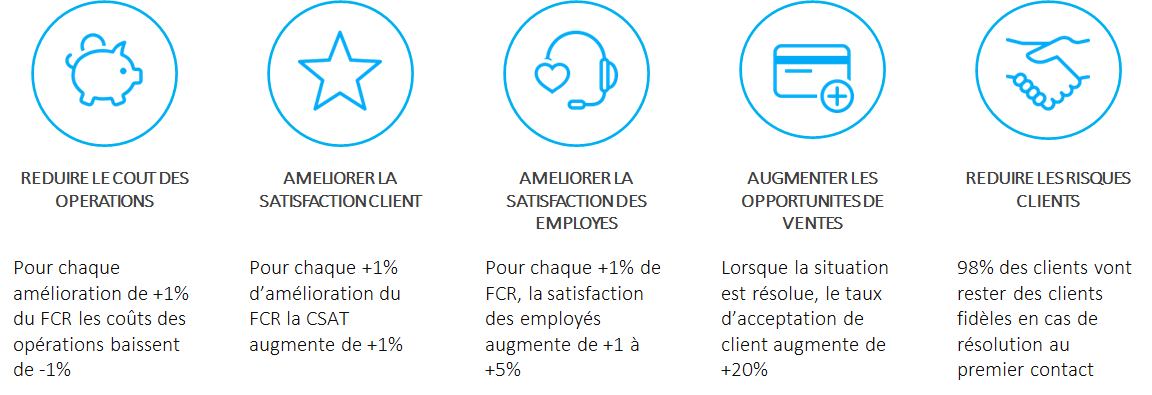
According to SQM, every 1% improvement in first contact resolution leads to:
- A +1% improvement in CSAT
- A -1% reduction in operating costs
- A +1% to +5% improvement in employee satisfaction
According to the same study, when an issue is resolved, the customer conversion rate increases by 20%, and 98% of customers remain loyal to the brand when their issue is resolved on first contact.
This virtuous circle of customer satisfaction shows that the FCR metric is interconnected with the other essential contact center metrics, such as CSAT, ESAT, costs and sales.
How to calculate FCR
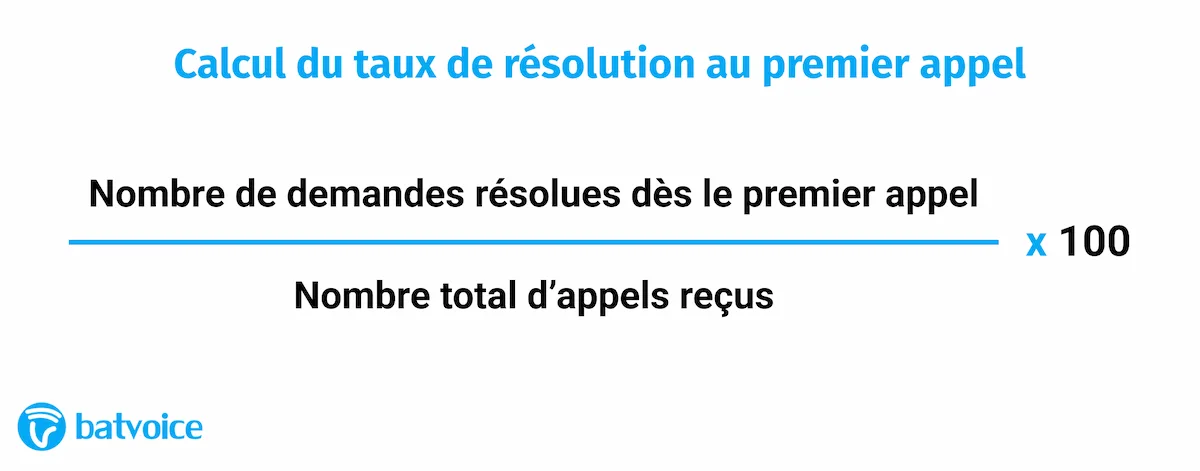
First call resolution is calculated by dividing the number of requests resolved on the first call by the total number of calls, then multiplying the result by 100 to get a percentage.
For example, if a call center receives 200 calls and manages to resolve 150 issues on the first call, the calculation is:
150 / 200 * 100 = 75%
A good FCR score is between 70% and 80%.
Measuring first call resolution using external data
“External data” means data based on direct customer feedback used to assess whether issues were resolved on first contact.
It is generally agreed to be the best source of information for measuring FCR accurately and assessing the quality of the customer experience.
However, response rates vary, which can limit how representative the data is. Customers may also be influenced by emotional or contextual factors when responding, which can affect objectivity.
Here are the main ways to collect this customer feedback:
Post-call phone survey
A post-call phone survey consists of calling customers after their initial interaction to ask whether they feel their issue was resolved on the first call. This method makes it possible to gather direct, immediate feedback on resolution effectiveness.
Pros:
- The customer determines FCR / whether their request was resolved
- High reliability
- Identifies dissatisfied customers
Cons:
- High cost
- Small sample, depending on customers' willingness to respond
- Processing time >1 day after the call
Post-call email survey
A post-call email survey involves sending customers an email after their initial interaction, asking them to answer questions to assess whether their issue was resolved on first contact. This method makes it possible to collect detailed feedback asynchronously.
Pros:
- The customer determines FCR / whether their request was resolved
- Low cost
- Identifies dissatisfied customers
Cons:
- Moderate cost (processing)
- Small sample, depending on customers' willingness to respond and email address availability
- Limited feedback (few questions, to maximize responses)
- Processing time >1 day after the call
Outbound post-call IVR (interactive voice response) survey
An outbound post-call IVR survey uses an interactive voice response (IVR) system to call customers after their initial interaction and ask them automated questions about whether their issue was resolved.
This method makes it possible to collect feedback quickly and automatically.
Pros:
- The customer determines FCR / whether their request was resolved (reliable individual response)
- Identifies dissatisfied customers (can be linked to CSAT)
- Low cost (automated process)
- Information available quickly
Cons:
- Small sample, depending on customers' willingness to respond
- Customers rarely enjoy interacting with a robot
Inbound post-call IVR (interactive voice response) survey
An inbound post-call IVR survey invites customers to answer a questionnaire via an interactive voice response (IVR) system immediately after their initial interaction, usually by staying on the line or calling a specific number.
This method makes it possible to collect instant, automated feedback on issue resolution.
Pros:
- The customer determines FCR / whether their request was resolved (reliable individual response)
- Identifies dissatisfied customers (can be linked to CSAT)
- Low cost (automated process)
- Information available quickly
Cons:
- Not very reliable, and sample-based
- Can be manipulated (agents may offer it only on successful calls)
- Limited feedback (few questions, to maximize responses)
- Customers rarely enjoy interacting with a robot
Survey by the agent during the call
In this method, the agent asks the customer directly, before ending the call, whether they feel their issue has been resolved.
This method makes it possible to collect immediate, direct feedback on the quality of the resolution.
Pros:
- Cost absorbed into the customer service process
- Involves the agent in tracking FCR
- Can be linked to the quality management (QM) process
Cons:
- Agents dislike scripted questions
- The survey can harm the overall experience
- Can be manipulated (agents may offer it only on successful calls)
- Customers may not dare to be honest
- Limited feedback (few questions, to maximize responses)

Measuring first call resolution using internal data
Measuring FCR using internal data means using information collected through internal software and systems. These methods rely on analyzing interactions and call data to assess issue resolution.
These methods have the advantage of being more objective, as they are less subject to customers' emotional biases. This data can also be collected continuously and in real time, providing a constant view of performance.
However, internal data may not fully reflect customer satisfaction or perception. Analyzing this data can also prove complex, as it requires sophisticated tools and advanced analytical skills.
Here are the main methods used to analyze FCR with internal data:
Automatic detection of repeat calls
Automatic detection of repeat calls uses software to identify customers who contact customer service several times about the same issue.
Pros:
- Automated process
- Enables a quantitative approach
- Helps select calls to listen to for a targeted QM approach
- Based on significant data volumes
Cons:
- Based on deterministic, subjective resolution rules
- May differ from the actual FCR rate (+/- 10 to 20%)
- Limited feedback (no qualitative information)
Quality management
Quality management involves evaluating interactions between agents and customers, either by supervisors or by automated tools such as Batvoice, to check whether issues were properly resolved on the first call.
This method helps ensure high quality standards and identify areas needing improvement.
Pros:
- Based on existing quality management processes
- Enables agent coaching on the calls reviewed
- Costs absorbed into the quality process
Cons:
- High cost (call listening and processing)
- Small sample; based on deterministic, subjective resolution rules (quality analyst)
- May underestimate or overstate the actual FCR rate (+/- 10 to 20%)
- May feel intrusive to agents
CRM and ticket management
This method consists of using a customer relationship management (CRM) system to track and analyze support tickets. It determines whether customers' issues are resolved on first contact by checking ticket history and updates.
Pros:
- Based on existing systems
- Enables a quantitative approach
- Low cost (a checkbox in a drop-down menu)
- Identifies unresolved requests
Cons:
- Based on deterministic, subjective resolution rules
- Can be skewed by agents (subjective self-reporting)
- May differ from the actual FCR rate
- Limited feedback (little qualitative information in self-assessment)
Which method should you choose to measure your customer service FCR?
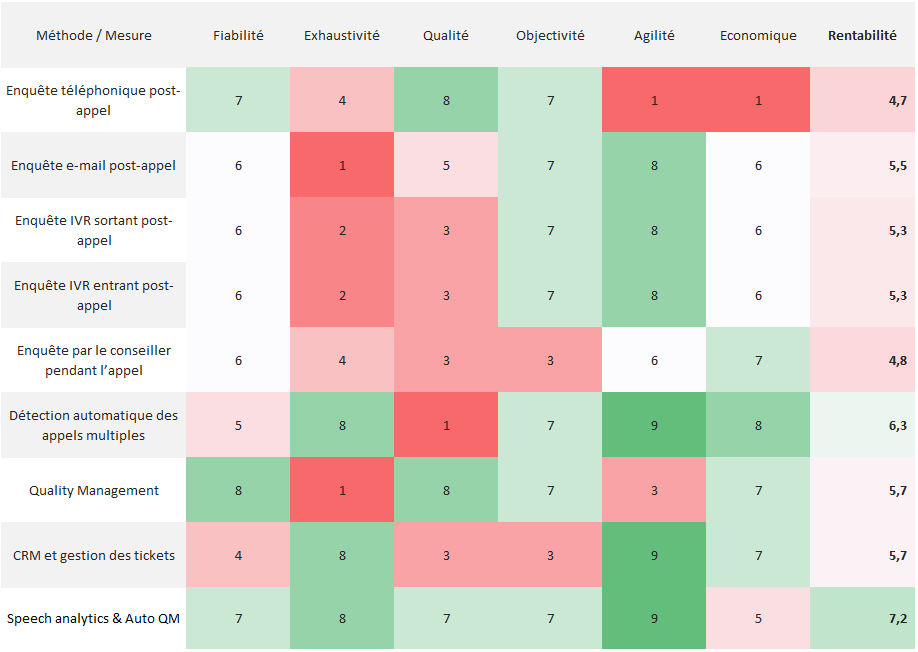
To manage your contact center's activities, it is essential to select one or more measurement methods so you have a complete view of your performance and can balance the pros and cons.
The question is how to reconcile:
- Comprehensive, reliable data for a statistical approach
- Qualitative content (customer feedback) to identify priority areas for improvement
- Automation for a smooth rollout without changing processes
- Return on investment
The best of both worlds: speech analytics and automated quality management
Artificial intelligence provides some answers, with speech analytics applied to the voice of the customer and to quality management processes. This technology consists of analyzing every call in a contact center and extracting both quantitative and qualitative data from them.
Pros:
- Comprehensive analysis (all recorded calls)
- Instant, continuous call processing
- High reliability
- Identifies dissatisfied customers (pain points, strong anger) and links them to automated actions
- Captures spontaneous customer feedback with no extra step, thanks to voice of the customer analysis
- Helps identify agents' areas for improvement and track their progress continuously (quality management)
- Automates the identification of repeat calls and the reasons for them
Cons:
- Requires teams to engage around the voice of the customer (VoC) to launch actions on cross-functional company processes
- Additional costs may sometimes be needed for consulting support
- Analysis models are sometimes generic (depending on the speech analytics solution) and may lack precision for certain industries
- ROI is hard for the company to measure and requires the speech analytics vendor's expertise
- Generic AI models are sometimes offered: they perform worse than specific models (specifically calibrated AI requires more effort and cooperation for optimal performance)