
5 tips to improve FCR (first call resolution)


Improving your first call resolution rate is essential for any company that wants to deliver quality customer service.
A high FCR means customer problems are resolved on the first contact, which increases customer satisfaction and reduces operating costs.
In this article, we share 5 practical tips to optimize your FCR, strengthen customer loyalty and make your call center more efficient.

Why improve your FCR?
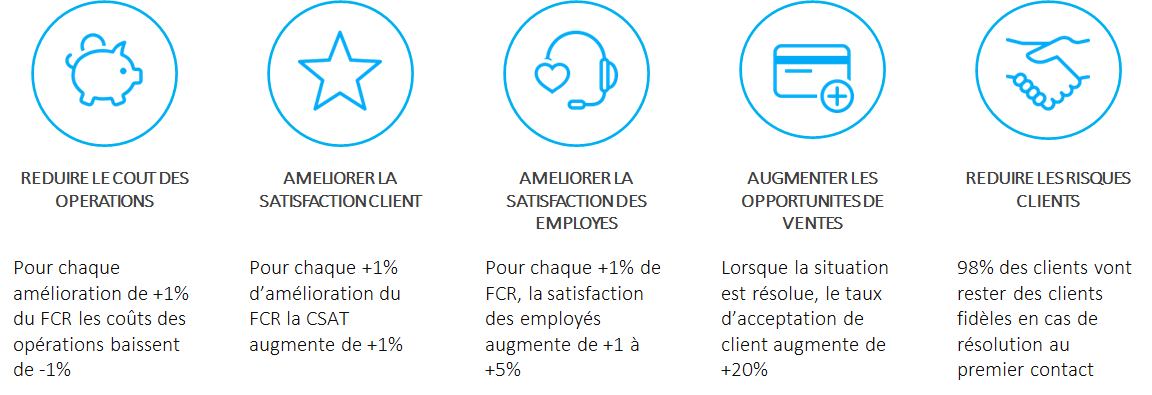
Improving your first call resolution rate brings many benefits for a call center or customer service team. According to SQM Group, every 1% improvement in first contact resolution leads to:
- A +1% improvement in CSAT:
FCR is directly linked to customer satisfaction. When customers see their problems resolved on the first contact, they feel greater trust and have a better overall experience, which strengthens their loyalty to the company.
- A -1% reduction in operating costs:
Improving FCR also improves operational efficiency. Fewer repeat calls mean lower call volumes, allowing agents to focus on new problems and manage their time more effectively.
- A +1% to +5% improvement in employee satisfaction:
A high first call resolution rate helps improve agent morale and productivity. Agents who manage to resolve problems quickly and effectively feel greater job satisfaction and experience less stress. It can also reduce staff turnover, as agents are more inclined to stay in a positive, rewarding work environment.
In short, the tips in this article address not only the challenges of improving and tracking FCR, but also other key metrics such as CSAT, ESAT, conversion rate and sales.
Tip #1: Access your phone call data
The challenge for many contact centers is accessing phone conversation data in a usable form, so they can take concrete retention and quality improvement actions while complying with GDPR requirements.
To make this data easy to access and act on, Batvoice AI's speech analytics technology lets you:
- Automatically transcribe every call in your contact center
- Structure this data using a taxonomy tailored to your industry
- Surface call reasons and the topics customers raise
Batvoice AI provides analysis tools for both voice of the customer and quality management. In addition, our teams support you operationally, tracking your ROI before your project starts and continuously while you use the platform.
Tip #2: Identify pain points in the customer journey
Counting and categorizing the topics customers raise lets you accurately identify and prioritize a wide range of issues to work on, such as:
- How many times your customers call your contact centers back
- Customer call reasons
- The number of promoters and detractors
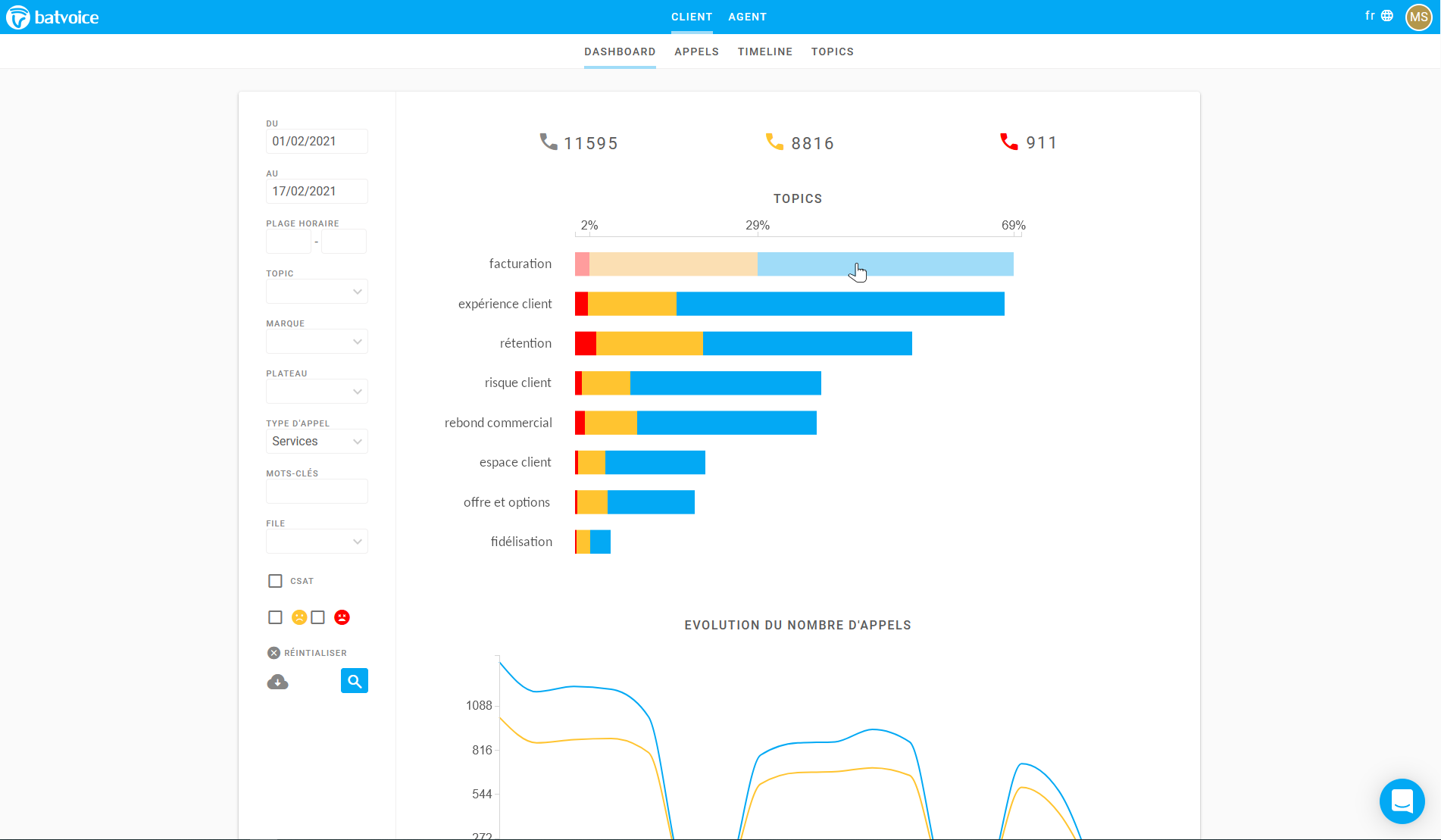
For better topic analysis, a speech analytics platform such as Batvoice lets you precisely trace recurring elements of what customers say, by volume and proportion. These include, for example, the recurring questions your customers ask and the pain points in the customer journey.
In the example below, the company has access to all the topics raised by customers and can measure these topics and subtopics by volume or percentage. Using filters, the company can also browse calls and replay segments of customer calls or the entire call.
Tip #3: Identify at-risk calls and get real-time alerts
Identifying and reacting quickly to at-risk calls is essential for customer satisfaction and retention, and therefore to prevent customers from leaving. By resolving critical issues on the first contact, you show customers that their concerns are taken seriously, which strengthens their trust and loyalty toward the company.
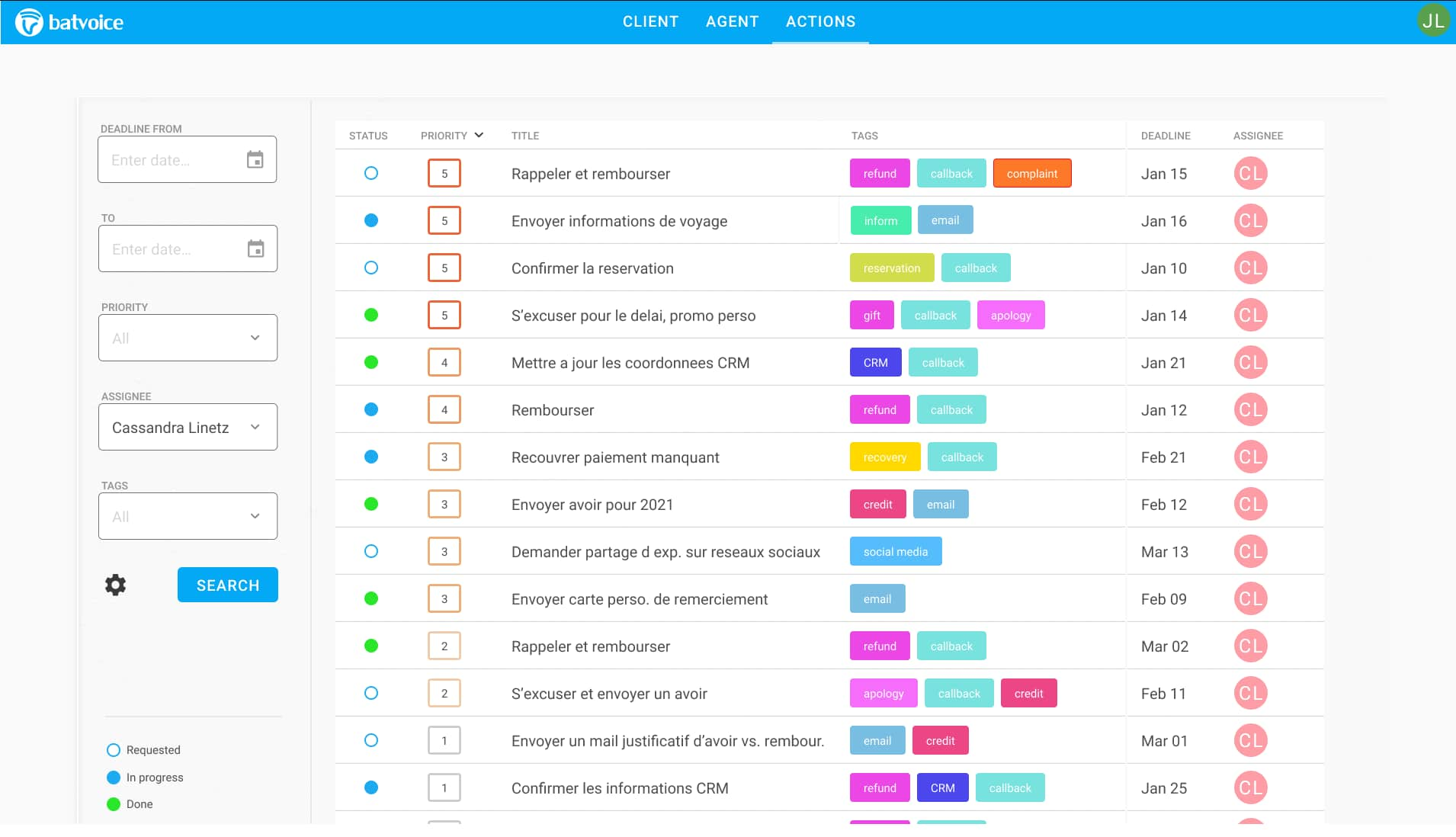
To track at-risk customers and identify the risk of callbacks, Batvoice AI lets you apply a variety of identification criteria such as the CSAT score or keywords and emotions in the customer's voice (such as anger or pain point detection). Based on these identification rules, the platform gives you real-time access to a list of at-risk calls.
Here are two examples of alerts for at-risk calls:
- With the keyword approach: during a customer–agent conversation, when the customer uses specific phrases such as "this is the last time I use your services", the keyword detection rules you have chosen will display these calls in your call tracking list.
- With AI assistance: AI automatically identifies call reasons and customer emotions and associates an action with them, for example: "The request [access to customer account] is unresolved and the customer's anger level is high". Teams then receive a daily report of calls at risk of customer churn so they can act immediately.
With this visibility, companies set up priority customer callback processes based on the number and intensity of pain points. For example, they call back customers who expressed strong anger in order to turn detractors into promoters and keep them from leaving for a competitor.
Tip #4: Target priority training actions
Agent training and the quality of customer conversations are crucial to improving first call resolution (FCR).
Well-trained agents have the skills and knowledge needed to identify and effectively resolve customer problems on the first contact.
Clear, consistent customer messaging enables accurate, reassuring communication, reducing misunderstandings and the need for follow-ups. Together, these elements increase customer satisfaction and operational efficiency.
Offer targeted training to agents to help them handle the situations that lead to customer callbacks, which streamlines the processes and operations behind those situations.
In addition, employees will feel more competent and confident in their ability to solve customer problems, which reduces the stress caused by uncertainty and difficult interactions with customers. Feeling better prepared and more effective, agents experience greater job satisfaction, which improves their well-being at work. As a result, satisfied, less stressed agents are better able to deliver quality service, leading to higher customer satisfaction.
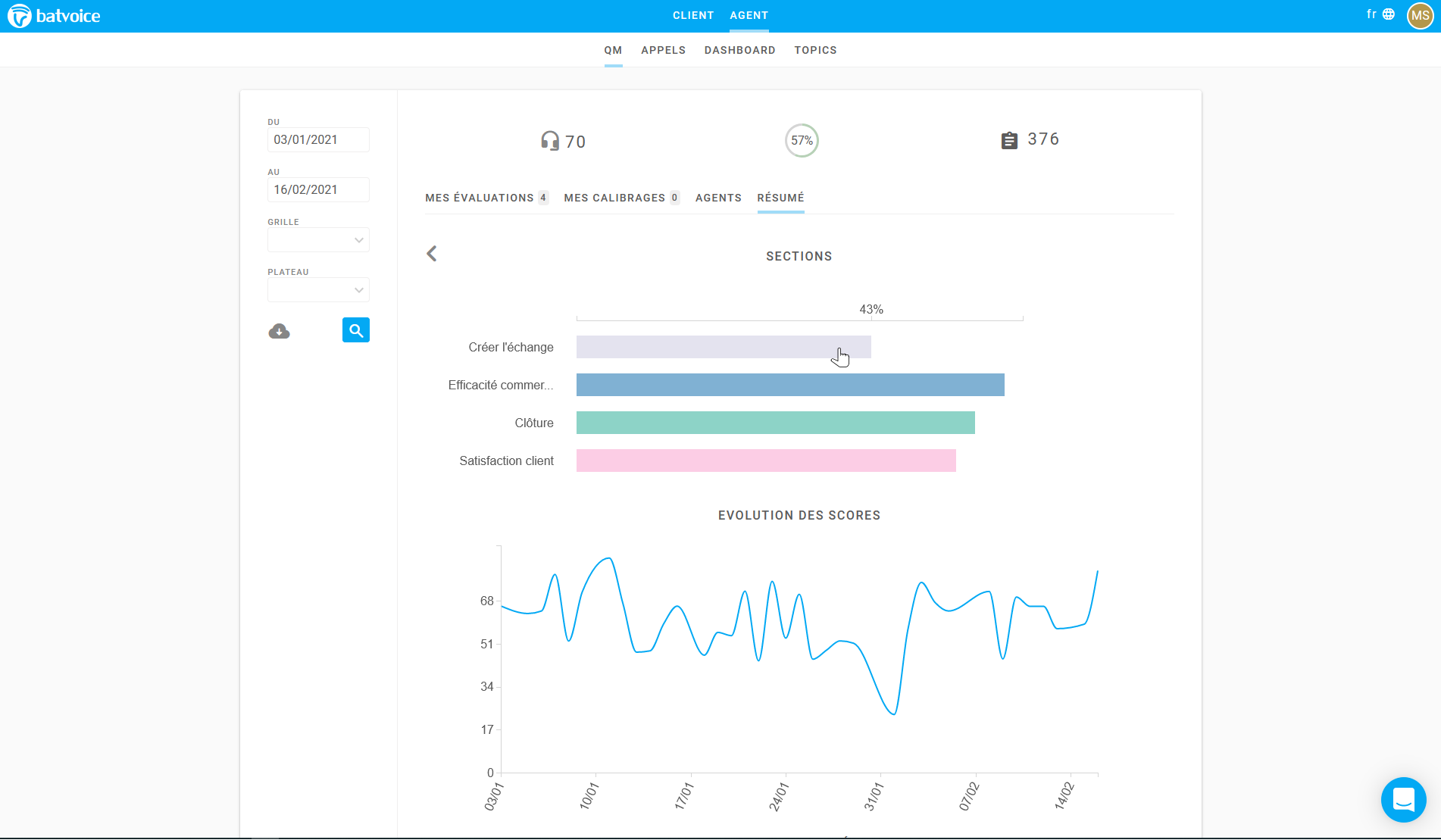
With its quality management features, Batvoice AI gives its customers a space to evaluate their agents and better identify their training needs.
Tip #5: Track the impact of your actions
One of the biggest challenges for companies is tracking the impact of their actions. When an initiative is put in place, it is essential to measure its effects on first call resolution (FCR), customer pain points and the quality of agents' conversations.
Batvoice AI makes this easy with a timeline that measures how each topic and subtopic evolves over user-defined periods (hours, days, weeks or months).
Companies can thus use dashboards to visualize trends and compare performance before and after actions are implemented. They can also export reports or easily track performance thanks to automatic email delivery of results at the frequency of their choice.